
Great ideas are born at ENTRANCE. ENTRANCE – Centre of Expertise Energy, is an innovative knowledge center focused on accelerating the energy transition. Here, companies, researchers, students, and governments collaborate on sustainable solutions.
For his third-year internship at Hanze University of Applied Sciences (Industrial Product Designer), Jelle Kemperman conducted research at EnTranCe on underground solutions for grey water storage: “The project I was fortunate enough to work on is called Floating Future. This is a large, long-term project focused on living on water. Due to climate change and rising sea levels, this is becoming increasingly important. Within the Floating Future project, there are all sorts of sub-questions, for example: How do you keep a floating house stable, how do you manage your energy supply, and how do you manage water storage and waste?” My research focuses on the design of an underground greywater storage tank in a terp, the Dutch word for dwelling mound.

Jelle sees opportunities for more intensive use of terps. “Heavy rainstorms are becoming increasingly common. Data from the Royal Netherlands Meteorological Institute (KNMI) shows that the number of days with more than 50 mm of rain in the Netherlands has almost doubled in the past 50 years.” Terps were once constructed to prevent flooding, but nowadays the space in and around them is not optimally used. This is a shame, because water could be stored there for periods of drought.
The underground greywater storage that Jelle is designing must be sustainable and use space efficiently, so that people can continue to live on top of the terp. Jelle says: “The terp not only protects against flooding but also stores water for dry periods, which is sustainable.” The researcher formulated several important requirements: “The storage must be able to hold approximately 10,000 liters. The product must not float, even when the groundwater level is high.” The tank must be able to withstand the ground pressure and be constructed of a suitable and durable material.


During his research, Jelle first delved into existing knowledge about terps and water storage: “I studied the history of water storage and terps. For example, water cellars in terps, and how modern technologies like smart sensors, foil basins, and rainwater cisterns contribute to efficient water management today.”
He also researched existing solutions: “I investigated both above-ground and underground solutions for water storage and infiltration, such as wadis, water tanks, infiltration crates, rainwater cisterns, and water cellars.”
The Hanze student had to meet a substantial set of requirements: The capacity requirement was calculated for a four-person household. The structural strength had to meet underground application requirements, the greywater storage had to be watertight, and the insulation had to be sufficient to prevent freezing in winter. “What stood out during the research is that plastic tanks are often used for greywater storage. They are relatively inexpensive, lightweight, and highly resistant to chemical influences. Concrete has the advantage of being very strong and doesn’t float easily, but concrete is heavy and more expensive to transport and install. Fiberglass is lighter than concrete and very strong, but also the most expensive option.

Image: Remco Kleine, Jorn de Ruiter, Jack Koppe, Tim Boijengamodule, drive systems from the Engineering course
After weighing all the properties, HDPE (High-Density Polyethylene) emerged as the best option. “HDPE is strong, highly resistant to moisture, easy to process with rotational molding, relatively lightweight, and also durable. This combination makes the material well-suited for use in underground applications such as this graywater storage facility.”
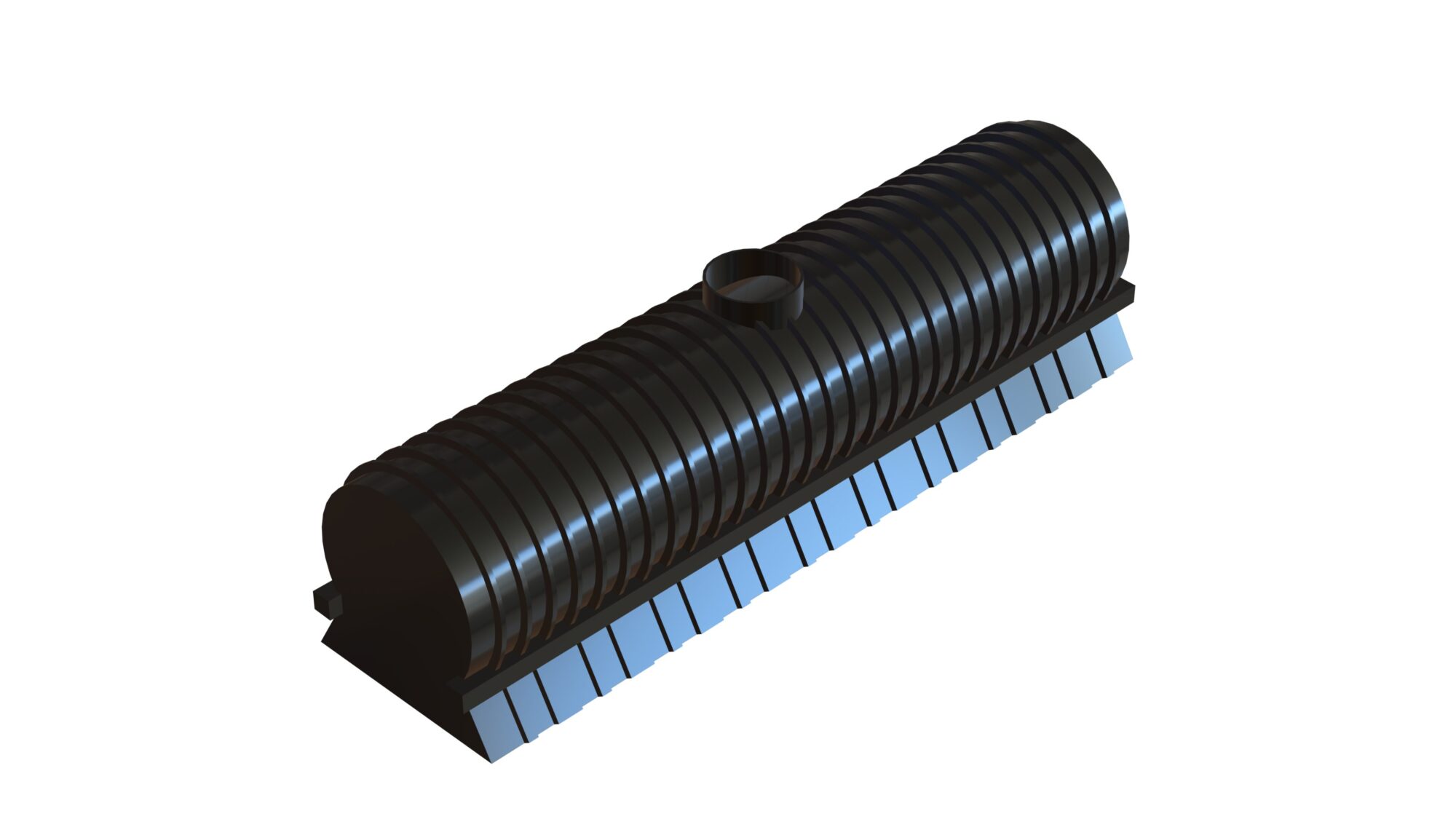
After selecting the material and determining all other design requirements, Jelle developed an initial concept for his tank: “After selecting the best concept, I made several adjustments to further improve the design, particularly with regard to the ground pressure. For example, the walls have been thickened, the shape of the ribs has been adjusted, and minor improvements have been made, resulting in a cleaner and more streamlined overall appearance.

The end result is an elongated tank with a cylindrical top that connects to a trapezoidal base: “Unfortunately, a physical model could not be created. However, the design has now been developed in such a way that it is ready to be sent to a supplier, who could, in principle, produce the product.”
As an added bonus for the research process, the design has been requested to be presented at the major event “The New Energy Forum,” which focuses on innovative projects and sustainable solutions.
Images: Jelle Kemperman. The header image is AI generated.
Leave a Reply