
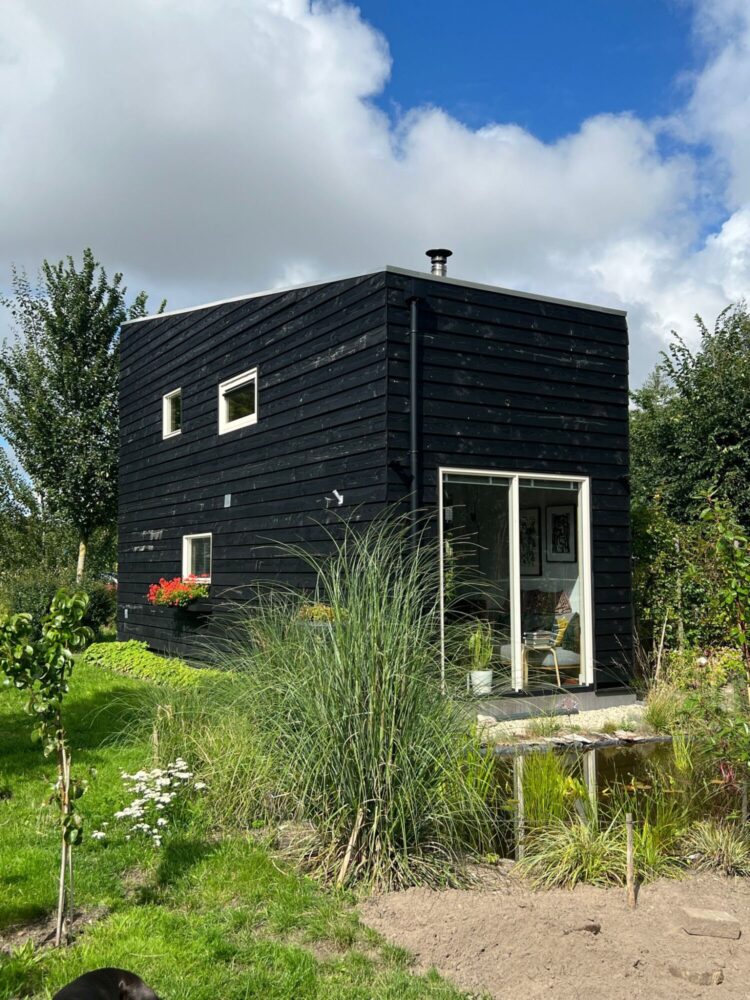
Marina is a pedagogue and co-owner of the practice for family and relationships, together with her partner Gideon de Haan. For some years now they have been the proud owners of a piece of land at Falgatuinen, Den Helder. Here they live in an off-grid Tiny House. Marina corrects with a smile: ‘We actually live ‘semi-off-grid. We do have a permanent water and wifi connection!’
Marina and Gideon chose a Tiny House from their hearts: ‘We work from home. For our practice for family and relationship therapy, we would like to sit together with the couples we help. And it works extra well if that can be done in a detached house. We increasingly have multi-day sessions. We are finishing our guest house, so that in the future guests can also stay at our location.’

Heating and grey water
The off-grid pioneers heat their water with a geyser and cook on gas. ‘So we regularly buy a bottle of propane.’ They heat their house with a wood stove, but have also taken into account the position of the windows. ‘On the south side, we have a large window that, especially in the autumn, provides a large part of the heating during the day, when the sun is shining. This is also the reason why we did not choose the most insulating glass. This way we don’t keep all the heat outside.’
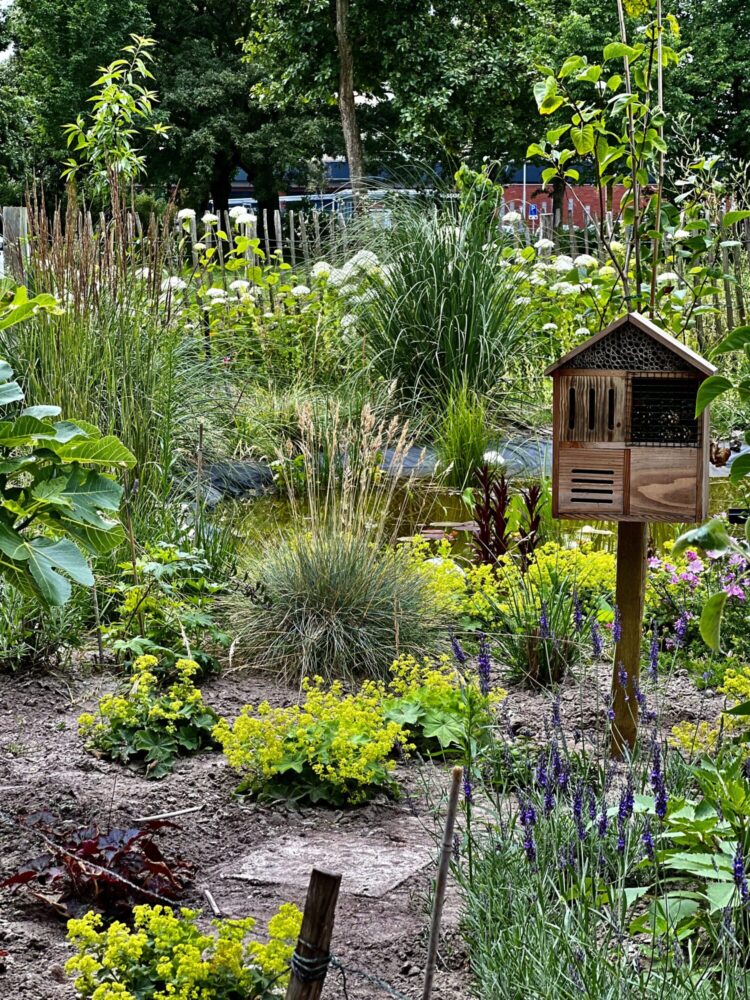
The house is also self-sufficient in terms of sewage: ‘We opted for an IBA: a system of a number of rooms through which grey water flows, which is cleaned and then discharged into the garden via a drainage hose underground. This does not always work smoothly and can sometimes cause blockages. We are prepared for this, but are toying with the idea of replacing the system with a helophyte filter, which our neighbours have had good experiences with.’

‘Our dry toilet is the ‘Villa’, which is now world-famous among Tiny House residents. It is a great toilet! In our previous ‘big’ house we sometimes had blockages, but that suffering is now far behind us. In the beginning we had to swallow the idea that you collect the faeces in a container and then have to do ‘something’ with it. In practice, it is not that bad. Visitors sometimes have to get used to it and our clients in the psychology practice are a bit surprised by the explanation about “toilet paper after use here” and “a cup of water after peeing there”. But everyone manages it!’

Solar panels and energy storage
As for the solar panels and batteries, which they purchased from the Offgridcentre, they are actually pleasantly surprised year in, year out: ‘The system works excellently and we almost always have enough energy with our two batteries. Unless the weather is very grey and dull. Then we can fall back on the battery of a neighbour’s car. That is luxury! There is also a communal battery that we as neighbours can use to charge, at a cost, and to (re)charge our batteries with.’
They are still thinking about how to tackle water collection. ‘We see the need and want to make a decision about this next autumn. These will most likely be IBC tanks that we will build a conversion around in the style of our house. The eye also wants something.’
It is nice to see how fast all the developments are going when it comes to off-grid living. We now see that the people around us, who live in a ‘normal’ house, are also seriously looking at solutions when it comes to storing electricity. We have been promoted from “a bit strange people” to “smart people”.


Off-grid tip from Marina:
The fact that all the developments are now going so fast also means that you almost automatically lag behind with every purchase you make; within a very short time a better, more effective or larger product has been launched on the market. These rapid developments also mean that it is important to obtain good information; sometimes the latest of the latest is not the best. We are glad that we listened to this advice when purchasing our electrical system. We know that we have to take into account that we will have to make adjustments or even replace things in a few years. For now, our installation is fine and we are closely following the developments.

Marina’s most important tip:
If you have doubts about tiny living: do it! There are more and more possibilities to arrange the ‘tiny life’ in such a way that it fits your lifestyle. And with this tip comes the wish that we as tiny residents do not measure each other against a yardstick of “real” or “better” but support each other in the choices we make. All in our own way, all taking care of our earth and living environment.
Leave a Reply